![[ABSD] White Logo.png](https://static.wixstatic.com/media/c6ec9d_74fae8190bdc4b4bbae4d07cc36b8aff~mv2.png/v1/fill/w_193,h_48,al_c,q_85,usm_0.66_1.00_0.01,enc_avif,quality_auto/%5BABSD%5D%20White%20Logo.png)
What LiDAR and Surveying Services Are Available in the Philippines — and Which One Does Your Project Actually Need?
One of the most common misconceptions about LiDAR surveying is that it is a single, uniform service. In reality, it is a family of technologies, each designed for different terrain, different environments, and different project objectives. Choosing the right method is not a technical formality. It directly determines whether your data can answer the questions your project depends on.
This article walks through the full range of LiDAR and geospatial surveying services available in the Philippines, what each one is best suited for, and how they can be combined to give planners, developers, and government agencies a complete and seamless picture of any environment.
If you are new to LiDAR, we recommend starting with our introductory guide, "LiDAR Surveys for LGUs: What You Need to Know Before Commissioning One." or "5 Considerations When Selecting a LiDAR Survey Provider".
Why One Method Is Rarely Enough
Every surveying method has a ceiling — a point where the terrain, the environment, or the level of detail required exceeds what a single approach can deliver. A topographic LiDAR survey tells you everything about the land surface, but nothing about what lies beneath a river. A drone covers a small area with precision, but cannot efficiently map thousands of hectares. An aerial survey captures rooftops, but misses the structural detail at street level. And no optical system, however advanced, can see through water deep enough for offshore development.
The best outcomes come from understanding which method — or combination of methods — is right for your specific problem. Here is what is currently available.
Aerial LiDAR Surveying
Best for: Large-scale topographic mapping/topographic surveying, urban planning, infrastructure, Disaster Risk Reduction Management (DRRM), renewable energy (wind farm/solar farm)
Aerial LiDAR surveying is the most widely applicable method for large-area coverage. A LiDAR sensor mounted on a manned aircraft fires laser pulses toward the ground and records the precise distance of each return, building a highly accurate three-dimensional model of the terrain below.
The distinction between manned aircraft and drone-based LiDAR matters significantly here. A manned aircraft can fly continuously for hours, covering thousands of hectares in a single flight. A drone, by contrast, is limited by battery life and must make multiple shorter flights to cover the same area, producing more individual datasets to stitch together, more opportunity for error, and considerably longer processing times. For large-scale mapping typical of LGU surveys or major infrastructure projects, manned aerial LiDAR is the more efficient and reliable choice.
Equipment quality is equally important. AB Surveying and Development's (ABSD) aerial LiDAR system has a maximum measurement range of 2,450 meters, meaning it can capture accurate ground returns from altitudes of up to 2,450 meters and beyond — a capability that depends on both laser range and the sensor's multiple return capability. This allows for greater area coverage per flight pass, reducing the number of flights required for large-scale surveys. ABSD's system supports up to 15 returns per pulse, compared to the 5 returns typical of many drone-based systems. This matters most in vegetated areas, which cover a significant portion of the Philippines.

When a laser pulse hits a tree canopy, a sensor with high multiple return capability continues recording as the pulse passes through gaps in the leaves, eventually reaching the bare earth beneath. A sensor with limited returns stops at the canopy — producing a Digital Terrain Model (DTM) that reflects the treetops rather than the ground. For flood modeling, drainage design, and contour mapping, this distinction is not minor. It is the difference between data you can build on and data that will mislead you.

The onboard Inertial Measurement Unit (IMU) is the third critical factor. No aircraft flies in a perfectly straight line — every flight involves constant pitch, roll, and yaw. A survey-grade IMU records these movements precisely so they can be corrected during processing, ensuring every data point lands exactly where it should in three-dimensional space. A weak IMU produces positional errors that compound across the entire dataset.
Because aerial LiDAR produces datasets containing millions — and in large-scale surveys, billions — of points, processing speed and accuracy are as critical as data acquisition. ABSD's proprietary AI-assisted processing platform accelerates classification workflows significantly, reducing what is traditionally one of the biggest bottlenecks in LiDAR project timelines. This is covered in more detail in the processing section below.
Aerial LiDAR surveying is applicable across a wide range of sectors and use cases, including urban and land use planning, flood hazard mapping, drainage system design, transmission line route surveys, onshore renewable energy site assessments (wind farms and solar farms), infrastructure corridor planning, and large-scale topographic mapping for government and private development.
Mobile LiDAR Surveying
Best for: Structure inventory, road assessment, urban detail capture
Where aerial LiDAR provides a top-down view of the landscape, mobile LiDAR fills in what the aircraft cannot see. A LiDAR sensor mounted on a moving vehicle scans the surrounding environment as it travels — capturing facades, street-level geometry, road surfaces, and the sides of structures that an aerial survey would never record.
For LGUs (Local Government Units) conducting structure inventories, this is particularly relevant. Aerial LiDAR captures rooftops and general building footprints well, but the vertical surfaces of structures — walls, facades, signage, ground-floor detail — are only visible from street level. Mobile LiDAR closes that gap, producing a comprehensive inventory that accounts for every structure in an urban area from all angles.

Beyond structure inventory, mobile LiDAR is also used for road condition assessment including pavement crack detection, corridor surveys for utilities and drainage systems, and street-level infrastructure documentation for engineering planning.
Terrestrial LiDAR Surveying
Best for: Detailed as-built documentation, engineering inspection, heritage preservation
Terrestrial LiDAR takes precision to its furthest point. Mounted on a stationary tripod, the sensor rotates to capture a full spherical scan of its immediate environment, producing a point cloud of extraordinary resolution and detail.
This is the method of choice when the level of detail required exceeds what any moving platform can deliver: documenting the precise geometry of a geothermal plant including every pipe and valve, capturing the structural condition of a bridge for engineering assessment, recording the exact dimensions of a building for as-built verification, or detecting hairline cracks on structural walls.


One of the most compelling applications of terrestrial LiDAR and one already practiced in other countries is heritage preservation. By creating a complete, millimeter-accurate digital record of a heritage structure, terrestrial LiDAR ensures that if the building is ever damaged or destroyed by fire, earthquake, or other disaster, it can be reconstructed detail by detail from the scan data. The Cologne Cathedral documentation project is one well-documented example of this approach in practice, and it represents a model worth considering for the Philippines' own heritage sites. Read the study here
Aerial Bathymetric LiDAR (One of the methods for Bathymetric Surveying/Hydrographic Surveying)
Best for: Shallow water mapping, coastal surveying, protected areas, port development
Standard topographic LiDAR uses a near-infrared laser that does not penetrate water. It simply reflects off the surface. Aerial bathymetric LiDAR solves this by using a green laser (532nm wavelength), which has the optical properties needed to pass through the water column and return from the seabed below.
Because the sensor is mounted on an aircraft, aerial bathymetric LiDAR can cover large shallow-water areas quickly and with minimal physical intrusion — an important consideration for environmentally sensitive zones such as coral reef areas, seagrass beds, and marine protected areas where a survey vessel would cause disruption.
The practical depth limit for aerial bathymetric LiDAR depends on water clarity. A useful field approximation uses the Secchi disk test: a disk is lowered into the water, and the depth at which it disappears from view is measured. Aerial bathymetric LiDAR can typically penetrate to approximately 2.5 times that depth. In highly turbid water, penetration may be limited; in clear coastal water, it can reach up to approximately 30 meters.
Common applications include port and harbor development, coastal zone management, submarine cable route planning, fish sanctuary and marine protected area mapping, offshore and nearshore renewable energy site assessment, shoreline change monitoring, and flood modeling in estuarine and coastal areas.

When combined with aerial topographic LiDAR, the result is a continuous, seamless elevation model that spans from inland terrain across the coastline and into the shallow seabed — giving planners and developers the full picture in a single integrated dataset.
Bathymetric Surveying Using Multibeam Echosounder (MBES)
Best for: Deep water mapping, offshore development, seabed characterization
For water depths beyond the reach of aerial bathymetric LiDAR, multibeam echosounder (MBES) surveying takes over. Rather than laser pulses, MBES uses sonar — sending acoustic signals from a transducer mounted on a survey vessel and recording the return signals to build a detailed model of the seabed.
MBES is the standard for offshore and deep-water surveying, capable of mapping the seabed at depths that no optical system can reach. It is the method of choice for any project where understanding what lies beneath deeper water is essential to the planning or engineering process.
Applications include offshore wind farm development, floating solar energy installations, submarine cable route surveys, dredging and reclamation projects, port approach channel surveys, river and inland waterway surveys, and offshore resource exploration.
ABSD operates its own dedicated survey vessel, allowing the team to mobilize for MBES surveys anywhere in the Philippines — including remote or logistically challenging locations — without depending on third-party vessel arrangements.
Geophysical Surveying Best for: Offshore Subsurface investigation, infrastructure planning, unexploded ordnance detection
Where MBES maps the surface of the seabed, geophysical surveying goes further — looking beneath it. For offshore projects where the composition and history of the seabed is as important as its shape, two methods are particularly relevant.
Subbottom Profiling
Using the Innomar SES-2000 parametric subbottom profiler, ABSD can image the sediment layers beneath the seabed — revealing the geological stratigraphy below the surface. For offshore infrastructure development, this information is not optional. The type and depth of sediment layers directly determines what kind of foundation a structure can support. For offshore wind farm development, for example, subbottom profiling data is what engineers use to determine whether a monopile, jacket, or floating foundation is appropriate for a given location — a decision that has significant cost and engineering implications.

Marine Magnetometer Survey
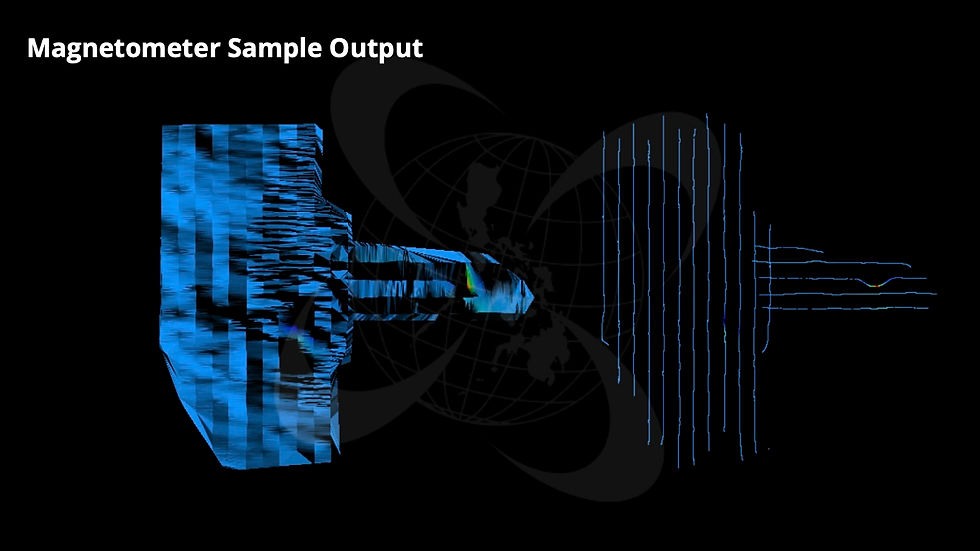
Using the G-882 Marine Magnetometer, ABSD conducts towed magnetometer surveys that detect the presence of ferrous objects beneath the seabed. This includes submarine cables, pipelines, and unexploded ordnance (UXO).
The UXO application carries particular relevance in the Philippines. As a country with significant World War II naval and land engagement history, Philippine waters contain a substantial number of undetected munitions and wreck sites. For any offshore development project, cable laying, dredging, wind farm installation. A magnetometer survey is an essential due diligence step before any seabed disturbance activity begins.
AI-Assisted LiDAR Data Processing How ABSD accelerates turnaround without sacrificing accuracy
Collecting LiDAR data is only the beginning. A single large-scale aerial survey can produce datasets containing hundreds of millions — or billions — of individual points. Each point needs to be classified: is it ground? Vegetation? A building? A road? A power line? Getting this classification right is what determines the quality of every deliverable that follows — the DTM, the contour maps, the flood models, and the GIS layers.
Traditionally, this classification process has been one of the most significant bottlenecks in LiDAR project timelines. Done manually, it is slow. And when providers lack the experience or processing capability to do it correctly, the results are wrong — misclassified points produce inaccurate DTMs, and inaccurate DTMs produce unreliable flood models, drainage designs, and planning outputs.
ABSD addresses this through a proprietary AI-assisted processing platform developed in-house. By automating the initial classification of point cloud data, the platform significantly accelerates processing timelines across all survey types — aerial LiDAR, mobile LiDAR, and MBES alike.
Critically, AI-assisted classification does not mean unreviewed classification. All outputs are manually verified by ABSD's technical team before delivery, ensuring that speed does not come at the cost of accuracy.
For clients, this means faster turnaround without the quality risks that have historically made processing a weak link in the LiDAR workflow.
GIS Software: Making Your Data Work for You
Collecting accurate survey data is only part of the equation. The value of that data depends on your team's ability to use it — to query it, visualize it, analyze it, and update it as conditions change.
ABSD is an authorized distributor of Global Mapper, a professional GIS software platform that integrates directly with LiDAR and survey deliverables. For LGUs and organizations without dedicated GIS teams, Global Mapper provides an accessible interface for working with geospatial data independently — without needing to commission a new analysis every time a question arises.
Practical applications include adjusting contour intervals for different planning purposes, running elevation-based flood simulations, toggling between the Digital Surface Model (DSM) and the bare-earth Digital Terrain Model (DTM) to switch between views of structures and terrain, generating flythrough visualizations so investors or planners can virtually navigate a project area without a site visit, and supporting structure inventory and property data management for tax mapping and assessment purposes.
For clients who adopt Global Mapper alongside their survey deliverables, ABSD provides a technical orientation — walking your team through the software and helping you configure it for your specific workflows and requirements.
Integrated Surveys and Recommended Combinations
The real power of these technologies emerges when they are used together. Below is a reference guide to which services apply to common project types, and which combinations are most effective.
Service | Best for | Environment | Typical sectors | Pairs well with |
Aerial LiDAR | Large-scale topographic mapping | Land | LGU, infrastructure, energy, agriculture | Mobile LiDAR, Aerial Bathymetric LiDAR |
Mobile LiDAR | Street-level structure and road capture | Urban areas | LGU, road management | Aerial LiDAR |
Terrestrial LiDAR | High-detail as-built documentation | Structures, sites | Engineering, heritage, energy | Aerial LiDAR |
Aerial Bathymetric LiDAR | Shallow water seabed mapping | Coastal, shallow water | Port development, marine planning, energy | Aerial LiDAR, MBES |
MBES | Deep water seabed mapping | Offshore, deep water | Offshore energy, cable, dredging | Aerial Bathymetric LiDAR, Magnetometer |
Subbottom Profiling | Sediment layer investigation | Offshore seabed | Offshore energy, infrastructure | MBES, Magnetometer |
Magnetometer | Ferrous object and UXO detection | Offshore seabed | Offshore energy, cable, dredging | MBES, Subbottom Profiling |
Global Mapper (GIS) | Data analysis and visualization | All environments | All sectors | All survey types |
Recommended combinations by project type:
LGU comprehensive mapping: Aerial LiDAR + Mobile LiDAR + Global Mapper
Coastal flood modeling: Aerial LiDAR + Aerial Bathymetric LiDAR + Global Mapper
Port or harbor development: Aerial LiDAR + Aerial Bathymetric LiDAR + MBES
Offshore wind farm development: MBES + Subbottom Profiling + Magnetometer
Submarine cable route survey: Aerial Bathymetric LiDAR + MBES + Magnetometer
Onshore renewable energy (wind/solar): Aerial LiDAR + Terrestrial LiDAR (for specific structures)
Heritage site documentation: Terrestrial LiDAR + Aerial LiDAR (for site context)
River or watershed management: Aerial LiDAR + Aerial Bathymetric LiDAR + MBES (for deeper channels)


Comments